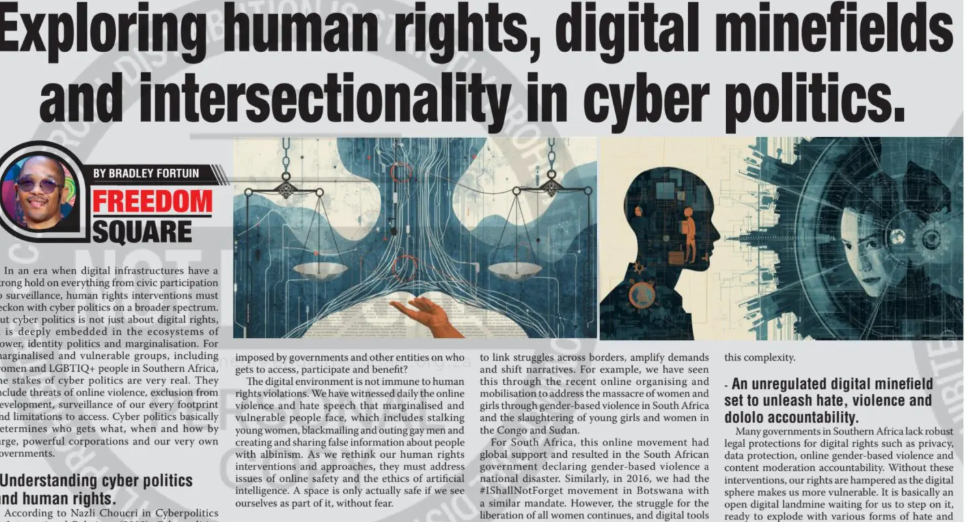
Southern Africa Litigation Centre (SALC): In an era when digital infrastructures have a strong hold on everything from civic participation to surveillance, human rights interventions must reckon with cyber politics on a broader spectrum. But cyber politics is not just about digital rights, it is deeply embedded in the ecosystems of power, identity politics and marginalisation. For marginalised and vulnerable groups, including women and LGBTIQ+ people in Southern Africa, the stakes of cyber politics are very real. They include threats of online violence, exclusion from development, surveillance of our every footprint and limitations to access. Cyber politics basically determines who gets what, when and how by large, powerful corporations and our very own governments.
Understanding cyber politics and human rights.
According to Nazli Choucri in Cyberpolitics in International Relations (2013), Cyberpolitics refers broadly to how politics, power, money, conflict, governance and human rights play out through and with digital technologies. This includes internet access, surveillance, data privacy, control of platforms and algorithms, digital activism and online hate and violence. With this understanding, governments, corporations and other power hungry entities compete for power and influence over our lives, our behaviour and our thinking.
But from a human rights lens, the key questions are: do we, as individuals and groups, enjoy our rights to freedom of expression, assembly, privacy, and protection from online violence? Are technologies created in a way that they contribute to or counter hate speech, online violence and further push vulnerable and marginalised groups to the margins of society, leaving us open to all forms of violence? Do they enable us to participate fully in civic and democratic spaces, or are there limitations imposed by governments and other entities on who gets to access, participate and benefit?
The digital environment is not immune to human rights violations. We have witnessed daily the online violence and hate speech that marginalised and vulnerable people face, which includes stalking young women, blackmailing and outing gay men and creating and sharing false information about people with albinism. As we rethink our human rights interventions and approaches, they must address issues of online safety and the ethics of artificial intelligence. A space is only actually safe if we see ourselves as part of it, without fear.
Read the full article on Exploring human rights, digital minefields and intersectionality in cyber politics